

Services
Eye Tests
At Christensen Harbison Optometrists, we are committed to providing every patient with a thorough, personalised service. To support this level of care, our practice operates under a private billing model for most consultations.
Private billing allows us to spend more time with each patient, invest in advanced diagnostic technology, and provide comprehensive assessments focused on your long-term eye health.
A standard eye examination is generally $110 and includes:
- Up to 45 minutes with one of our experienced optometrists
- Digital retinal imaging
- Eye mapping
- A thorough assessment of your vision and eye health
- Personalised advice on prescription eyewear and lens options, tailored to your visual needs
If your examination indicates that additional diagnostic testing is required, we will discuss this with you before proceeding. Additional fees may apply.
Patients receive a Medicare rebate of $67.85 or $34.00, depending on their eligibility.
Payment is requested in full on the day of your appointment. We process your Medicare claim electronically on your behalf, with your rebate being paid into your bank account within 1-2 business days. If you have any questions about our consultation fees or Medicare rebates, our friendly team will be happy to assist.
What to Expect
At Christensen Harbison Optometrists we’re known for providing award-winning customer service. In fact, we dedicate up to 50% more appointment time than other practices so we can best meet your visual needs. Here’s what you might expect at your appointment:

Step 1
Your Optometrist will get to know you and learn about your visual and medical history. They will discuss how you use your vision and what’s important to you.

Step 2
Using our retinal imaging technology, your eyes will be checked for signs of disease or degeneration.

Step 3
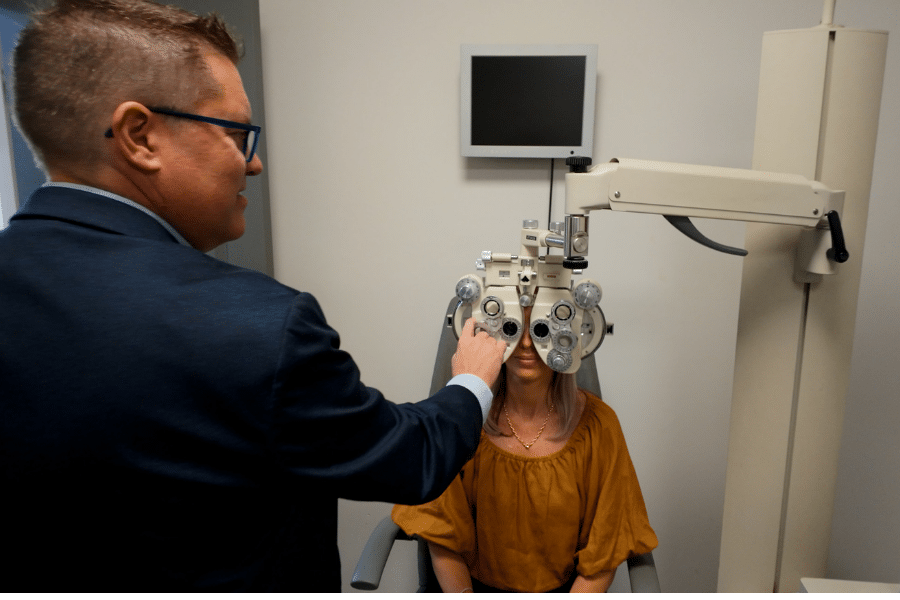
Your Optometrist will conduct visual acuity tests and refraction to determine your spectacle prescription. If spectacles are needed, your Optometrist will assist with your choice of frames and lenses.
Common questions asked by our customers
How much does it cost for an eye test?
Our practice privately bills most consultations. A comprehensive eye examination is generally $110. Patients receive a rebate of $67.85 or $34.00, depending on their Medicare eligibility. If your appointment requires additional testing or specialised services, different fees may apply. Our friendly team will be happy to explain the fees and Medicare rebates applicable to your appointment before you book.
What should I bring to my eye test?
Please bring all current glasses or previous contact lens prescriptions and any relevant medical reports about your eyes (if available).
How long should I allow for my eye test?
Grab a 1-hour car park, not because we’re tardy, but because we like to allow the time to ensure we get it right.
How often should I visit?
Children should have their first eye test before starting prep, or earlier if you have any concerns. Until age 60, a visit every two years is fine in general. Over age 60, annual visits are recommended to help identify diseases that are more common to aging eyes. More frequent visits may be necessary throughout your life if there is a family history of eye disease (or conditions that affect vision).
I have private health insurance – what does that cover?
Do you provide “free” glasses under the Government Spectacle Supply Scheme (SSS)?
Contact Lens Consultations
Many glasses wearers have the option to switch to contact lenses for practical or aesthetic purposes. For that initial switch, a consultation is needed to gauge eligibility and ensure that your contact lenses are well suited to your lifestyle and optometric needs. Our experienced Optometrists are qualified to prescribe a range of contact lenses, including specialty lenses to treat various eye conditions.
- Contact lenses for astigmatism
- Contact lenses for myopia control
- Rigid Gas Permeable (RGP)/hard contact lenses for keratoconus
- Custom coloured contact lenses to adjust eye colour
After care is crucial to responsible contact lens use so we will take the time to educate you on the process required to insert, remove and maintain your lenses hygienically and check in with you to ensure you remain on track.

Children’s Testing
Regular vision assessment is essential to children’s general health and wellbeing. Vision problems of varying severity are common in kids and can impact their ability to perform academically or interact socially if left untreated.
Children with vision impairment may not be aware of their problem because they’ve never experienced better vision but you may notice certain signs like:
- Leaning very close to books and having problems reading
- Sitting very close to televisions and other devices
- Squinting and/or rubbing eyes frequently
- Complaints of sore eyes, light sensitivity or headaches
Catching any of these issues early on allows for targeted intervention that can minimise any damage that might result. Whether these symptoms are present or not, have our friendly team guide your child through the eye examination process before they start school and continue to build the habit of consistent eye care.

Retinal Imaging
Digital Retinal Imaging gives us a painless, non-invasive way to look closely at the back of your eye. The level of detail available in the photographs that result allows us to detect eye disease much earlier and often before symptoms can be felt. By taking retinal images at different times over the course of your life, a collection of images from previous visits will exist that can be referred to if changes occur.
Accurate diagnosis at an early stage is crucial to maintaining vision or slowing decline depending on the condition that presents itself. As we age, and we become more susceptible to vision related issues, retinal imaging becomes an even more essential aspect of our eye health care process.

Myopia
Myopia, or short-sightedness, is where people don’t see distance objects clearly. Myopia typically worsens from childhood through to late teens or early twenties. If your child is diagnosed with myopia or identified as being at high risk of developing myopia, we will book them into our dedicated myopia clinic. This will include review for progression at least every six months, discussion of risk factors and lifestyle advice, and a treatment plan put in place. There is no cure for myopia, but with treatment, its progression can be slowed. Christensen Harbison Optometrists are endorsed to prescribe low-dose atropine eye drops. They have also completed the required accreditations to prescribe Hoya Miyosmart and Zeiss MyoCare myopia control spectacle lenses as well as Coopervision MiSight myopia control contact lenses.
Myopia control is an evolving field and Christensen Harbison Optometrists strives to stay at the forefront of best practice. For further information about Myopia visit www.mykidsvision.org or speak with your Optometrist.

